
The Soft Landing: Settling In Abroad Step by Step
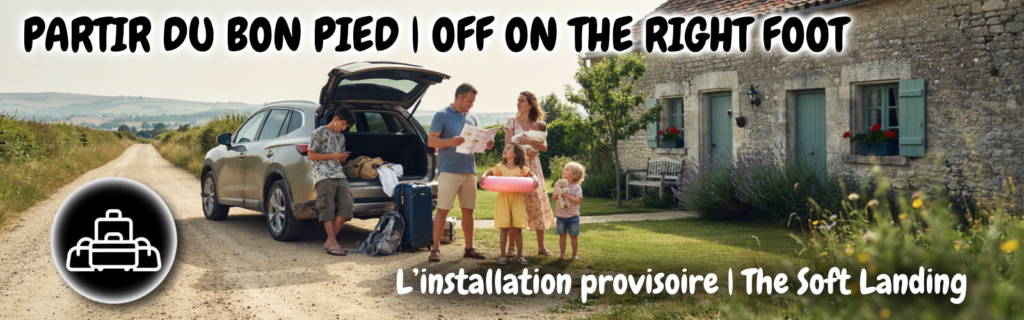
This is it… you’re about to leave for real!
I don’t know how your scouting trip went but, if all went well, you’ve picked a GPS point on this planet that you’re going to call « home ».
I’m not offering you THE way to find your dream home right away. Let’s start by limiting the disappointments, and the waste of time and money! Our family has moved some fifteen times, at home and abroad. They say experience is a comb you’re given once you’ve gone bald… so we’re lending you ours, before you lose your hair 😉
1 – A Soft Landing: The Furnished First Month
What you’ll be looking for online BEFORE YOU LEAVE, you’ll find on your preferred short-term furnished rental platform.
Avoid high season, of course. Off season, booking a place for a month can turn up some great deals: you’re nowhere near peak summer prices.
What’s more, it’s always better to view houses in a season that puts all their flaws on display: the factory hidden behind a curtain of trees… without their leaves, the supermarket car park… on a busy day, at rush hour, and so on.
So you choose short-term accommodation in the heart of your preferred « landing spot ». You bring just a few suitcases, not your whole household: enough to last two or three weeks. After all, you’re in a furnished rental, where everything is provided 😉
Now you’re free to start your search with no pressure and no rush.
Advantage no. 1: you can put the estate agency or agencies of your choice to work. You’ll be readily available for every viewing they arrange. At first, it’s RENTALS you want to see, with the shortest possible notice period to leave.
Advantage no. 2: at the same time, you stroll around town, go to the market or the shops, soak up the atmosphere at café terraces… in short, you take the pulse of YOUR future hometown.
Advantage no. 3: you « learn » your new territory and fine-tune your choice of location as you explore and view properties: north, south, near the motorway, close to schools, out in the fields… And if need be, you can change tack and try your luck elsewhere, since nothing ties you down! Another region, another setting…
2 – House Hunting, for Real
Now you can start looking for your « permanent » house or apartment. To rent or to buy…
With one important point to keep in mind. A rental moves very fast, both to sign and to give notice: you’re not tying yourself down. Buying property, on the other hand, can take some time… to put it mildly.
And since you won’t be staying forever in your first furnished place, nothing stops you from moving into a « regular » rental, with a lease and the shortest possible notice period, if your dream property is slow to turn up… especially if there’s work to be done before you can move in.
If you’ve decided to build, a rental in the meantime is a must!
3 – Hey… What About the Paperwork?
Yes, this is where the authorities have their say.
For now, you’re still a « tourist ». Make the most of it to apply for your tax identification number. For the time being, it will be linked to your address in your home country. In some countries, you can even get it before you leave, at the consulate.
Without it, as a rule, almost NOTHING can be done: no signing, no registering your lease. With this number in hand, you can sign your rental agreement. Then, for all your other formalities, you can – at last! – link your tax number to your new address. You could say your « administrative survival » depends on it.
The tax number deserves a fact sheet of its own, it’s that important, and the rules aren’t quite the same from one country to the next: here, we’re sticking to the main principles. Without it, you remain a tourist. That’s not illegal… but it can’t last forever!
Getting the administrative steamroller going is often daunting, and with good reason: everything is in a foreign language, and you don’t understand all the formalities, or any of them at all. Professionals can guide you through them in your language, you’ll find them in our directory… but yes, yes, some people manage on their own. It’s up to you to gauge your stamina 😉
4 – The Removal
Now that you’ve found your long-term nest (rented or bought), let’s talk about the move.
If everything fits in a few suitcases and the boot of your car, forget it!
But if you’ve left an apartment or a house full of a lifetime’s belongings, you’ll need another tactic.
Your removal company needs less than a week to deliver. But it can’t sit parked in the middle of nowhere waiting for a delivery address! Imagine it takes you two weeks to find a rental, sign the lease and try the keys (which is already quite fast, it could be three or four): what happens to your furniture, your paintings and everything else?
So your removal company will store, or have stored, all your belongings, well packed and insured, in a storage facility, usually near your place of departure. As long as you have no delivery address, that’s sensible of them 😉 And it takes the pressure off: you can take your time to view properties and choose.
As soon as you have your long-term rental or your very own property, one phone call is all it takes for them to schedule the delivery.
International removal companies know each other and work in networks: you may well not be delivered by the company that packed your things on departure. Don’t be surprised 😉
5 – And the Car? It Deserves a Chapter of Its Own!
If you’re moving with your car, read on carefully: a moment’s carelessness could cost you an arm and a leg.
In several countries, including Portugal and Spain, a car arriving from abroad pays a VERY STEEP tax when it is registered. But if you’re moving for good, it may be exempt… as long as you meet certain conditions, and can prove it.
The rules vary from country to country, and they change. The main principles are similar, though:
- the car has been in your name for some time before you leave (in Portugal, currently at least six months);
- you really did live in your previous country for some time (in Spain, at least twelve months);
- you apply within a set period after you settle in (in Portugal, twelve months);
- only one car per person, and no selling it straight away.
Coming from outside the European Union? Then you’ll also have to go through customs, and in Portugal, a customs broker (despachante) is a must.
A word to anyone tempted to treat themselves to a brand-new car just before leaving: bad idea! When we arrived in Portugal, six months of ownership were required. By the time we reached the fateful date… the rule had changed to one year. So we postponed our official residency paperwork by six months to keep the exemption. The savings? Thousands of euros!
The weak point of the file is often proof of where you lived before. So, just before you leave, ask your local authority for an official document confirming that you’re leaving the country for good, with your belongings and your car (registration number included), if such a document exists where you live. If not, a statement on plain paper should suffice, provided it is dated, signed, and stamped by a recognized authority. Keep some proof of your previous life too: utility bills, tax returns, rent receipts, the notice ending your lease.
If you forgot to get this valuable document made, the round trip (depending on where you come from) to fetch it might still cost you far less than the tax!
Above all, get help from a professional who knows the procedure in your new country (in Portugal, a solicitador or a despachante; in Spain, a gestoría) (they are all in our directory). They know the current rules, the exact list of documents and the deadlines. The savings can be SUBSTANTIAL!
A small formality… a huge saving!
That’s it!
There you are: you’ve arrived, settled in, and your furniture has caught up with you. All that’s left is to discover your new country… with stars in your eyes, for a long time to come!
Off on the Right Foot
This article is part of our « Off on the Right Foot » series, about future expats’ first steps in their new country.
We see too many newcomers struggle to adapt, then leave disappointed, feeling they were taken in by fine promises.
Settle in step by step, making sure each one works before moving on to the next. Take your time: your new country will wait for you… and you might just fall for it, gently, and never want to leave!
🇬🇧 This article was written in October 2026. Laws and regulations can change without notice. Please verify all details at the time of reading — and consult a professional, you’ll find one in our directory!

EMAIL
contact[@]pros4expats.com
RÉSEAUX SOCIAUX
Facebook
LinkedIn
© 2026 La Maison au Sud, LDA