English-speaking Dentist in Barcelona
English-speaking dentist in Barcelona: find the right professional stress-free
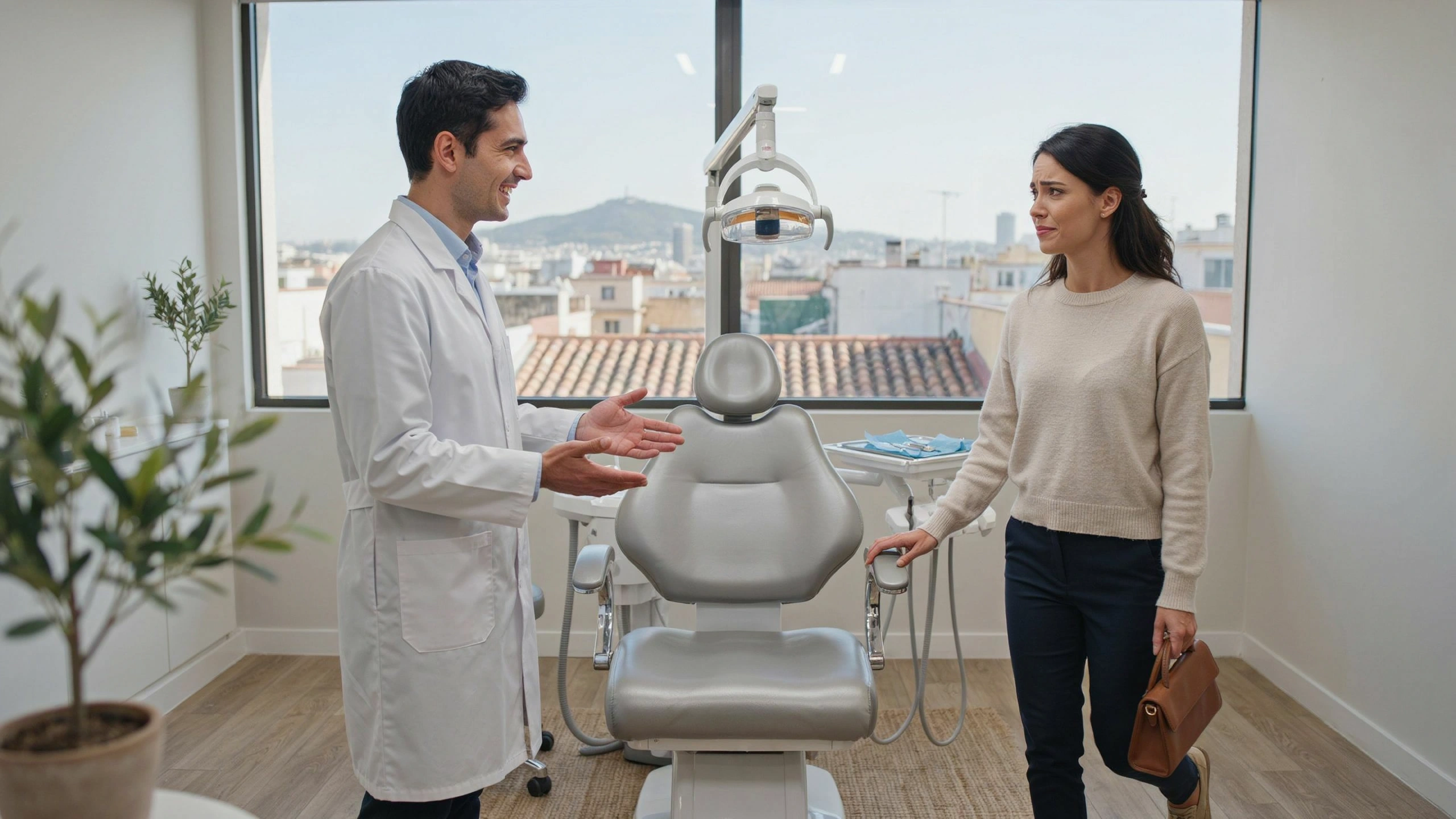
You’ve been putting it off. The dull ache that started last week, the sensitivity to cold that wasn’t there before — you know you need to see a dentist. But finding one in a foreign city, in a language you’re not fully comfortable with, adds a layer of stress that makes it far too easy to keep postponing.
Here’s the good news: English-speaking dentists in Barcelona are not as hard to find as you might think. And seeing one makes an enormous difference — not just for your comfort, but for the quality of care you receive. In this guide, we walk you through everything you need to know about dental care in Barcelona as an expat: how the system works, what to expect, and how to find the right professional quickly.
Why language matters so much at the dentist‘s
Dental consultations depend entirely on precise communication. To diagnose correctly, your dentist needs to understand exactly what you’re experiencing: where the pain is, what triggers it, how long it lasts, whether it’s sharp or dull, constant or intermittent. These nuances are difficult to convey in a language you don’t fully command.
But it goes beyond describing symptoms. Understanding the proposed treatment is just as important. When your dentist explains that you need a root canal, a crown, or an implant — you need to understand what that means in practice: how many appointments, what the recovery looks like, what you should and shouldn’t do at home, and what the alternatives are. That understanding simply doesn’t happen reliably through broken Spanish or a translation app held up between patient and practitioner.
And then there’s dental anxiety, which affects a significant proportion of adults. It is dramatically worse when you can’t fully understand what’s happening around you. Being able to say « I’m nervous », « can you explain what you’re about to do », or « I need a moment » in your own language — and have your dentist genuinely understand — changes the entire experience.
How dentistry works in Spain
The Spanish public healthcare system covers very little when it comes to dental care. Unlike some other European countries, adult dental treatment in Spain is almost entirely private. The public system covers dental emergencies in very limited circumstances, and children benefit from some basic coverage depending on the region — but for the vast majority of expats, dental care means private clinics and out-of-pocket costs.
This is worth knowing before you arrive, or shortly after. The sooner you identify a dentist you trust and establish a relationship with them, the better placed you’ll be when something urgent comes up.
The upside is that private dental care in Barcelona is generally excellent in quality and significantly more affordable than in the UK, Ireland, or Northern Europe. For routine treatments — fillings, cleanings, crowns — the difference in cost compared to your home country can be substantial. For more complex work such as implants or orthodontics, some expats find that even factoring in travel costs, treatment in Barcelona represents considerable savings without any compromise on quality.
Insurance and reimbursement for dental care in Barcelona
If you hold international health insurance or an expat health plan, check your dental coverage carefully before booking your first appointment. Policies vary widely: some cover emergencies only, others include routine care, and a smaller number extend to prosthetics and orthodontics.
Always ask your dentist for a detailed invoice — Spanish private clinics are well used to producing these for international patients. This document is what you’ll need to submit a reimbursement claim to your insurer, regardless of where they are based.
If you are covered by a European Health Insurance Card, be aware that it does not cover private dental treatment in Spain. It applies only to public healthcare, and as noted above, adult dental care falls almost entirely outside the public system here.
Some international insurers also offer direct billing arrangements with partner clinics in Barcelona — worth asking about when you call to make your first appointment, as it can simplify the administrative side considerably.

When finding an English-speaking dentist becomes essential
Some situations make the language barrier particularly problematic in a dental context.
A dental emergency is the most obvious one. A broken tooth, an abscess, severe pain — in these moments, being able to describe exactly what you’re experiencing is critical to receiving the right treatment quickly. Fumbling with translation tools when you’re in pain and anxious is the last thing you need.
Your first dental check-up after arriving in Barcelona is another key moment. This is when you establish your baseline, share your dental history, and begin a relationship with a professional who will follow your care over time. Starting that relationship in English means the communication will remain clear throughout.
Complex or multi-stage treatments — implants, orthodontics, periodontal treatment, oral surgery — unfold over weeks or months and involve detailed discussions about treatment plans, risks, alternatives, and progress. Having these conversations in English isn’t a luxury; it’s a clinical advantage.
And for children, the case is even clearer. Getting a child through a dental appointment requires skill, patience, and the ability to communicate reassurance naturally. An English-speaking pediatric dentist in Barcelona can talk directly to your child, not just to you — and that makes an enormous difference.
What to expect from a private dental clinic in Barcelona
Barcelona’s private dental sector is well-developed and internationally oriented. The city attracts dental professionals trained across Europe, and many clinics specifically cater to international patients — offering consultations in English, French, German, and other languages alongside Spanish and Catalan.
Equipment standards are high. Digital X-rays, optical scanners, CAD/CAM technology for same-day crowns — these are common in well-established Barcelona clinics. You are unlikely to find yourself in an underequipped practice if you choose carefully.
Waiting times for a routine appointment are generally short — often under a week. For emergencies, most private clinics offer dedicated slots or an emergency line. Some operate six or seven days a week, which is particularly useful if something goes wrong over a weekend.
How to find an English-speaking dentist in Barcelona
The British and American consulates in Barcelona maintain lists of recommended English-speaking medical and dental professionals. These are a reliable starting point, though not always comprehensive or up to date.
Expat communities — Facebook groups, online forums, local associations — are often the most practical source of personal recommendations. A first-hand account from someone who has actually sat in the chair carries more weight than any directory listing.
And then there is our directory. Pros 4 Expats lists English-speaking dentists in Barcelona and across Spain. You can filter by speciality, confirm the professional speaks English, and access their contact details directly. Free, no registration required, available immediately.
Which dental specialities can you find in English in Barcelona
Barcelona’s international medical community is broad enough to cover most dental specialities in English: general dentistry, paediatric dentistry, orthodontics, implantology, periodontics, endodontics, and cosmetic dentistry.
For more specialist needs, your English-speaking general dentist is often the best person to guide you toward trusted colleagues. Dentists who work regularly with expat patients tend to know the international network in the city well and can refer you with confidence.
Preparing for your first dental appointment in Barcelona
A little preparation makes your first appointment significantly smoother. If you have recent dental X-rays — a full panoramic or individual shots — bring them. They allow your dentist to assess your situation without repeating examinations already done, and they provide a useful baseline for ongoing care.
Note down your dental history before you go: existing crowns or bridges, previous root canals, any known allergies to local anesthetic or dental materials. If you take any medication that affects clotting or your immune system, mention it at the start of the consultation.
If you have dental anxiety, say so when you book — not just when you arrive. An English-speaking dentist in Barcelona who works regularly with international patients will be familiar with this, and can adapt: shorter appointments, step-by-step explanations, or light sedation if needed.
Finally, ask for a written treatment plan and cost estimate before committing to anything beyond an initial check-up. This is standard practice in Spanish private clinics, and you are entirely entitled to take time to consider it, ask questions, or seek a second opinion.
Conclusion
Finding an English-speaking dentist in Barcelona doesn’t have to be stressful — and it shouldn’t be. The professionals are there, the quality is high, and the costs are reasonable. All you need is to know where to look.
Our directory is here to help you find the right dentist quickly, in your language, with no unnecessary complications.
123 PROFESSIONS IN OUR DIRECTORY… IF YOURS ISN’T THERE, IT MUST BE A RARE BIRD.
FIND THE PRO YOU’RE LOOKING FOR – IT’S FREE!
EMAIL
contact[@]pros4expats.com
RÉSEAUX SOCIAUX
Facebook
LinkedIn
© 2026 La Maison au Sud, LDA