
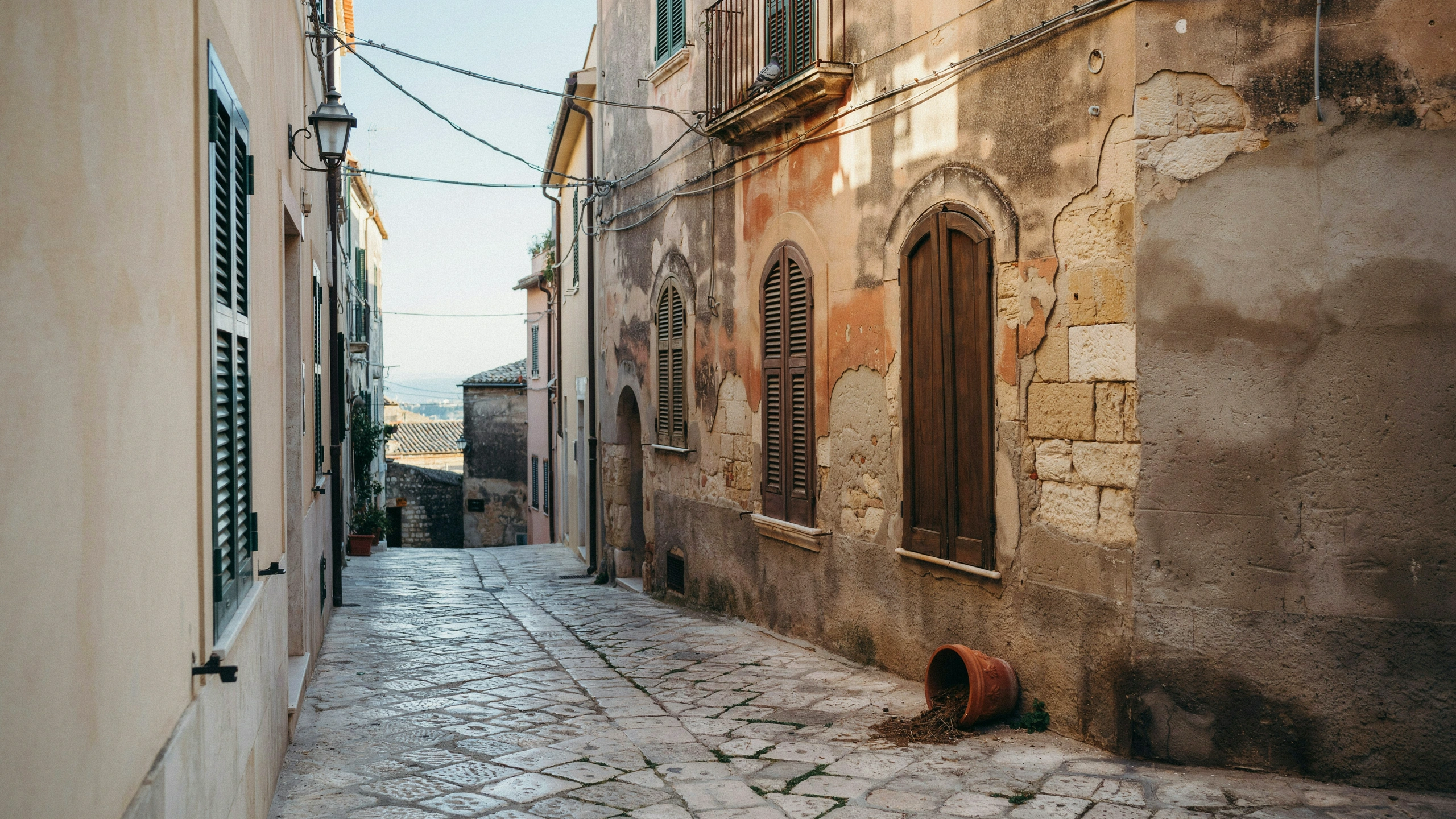
1 Euro House in Italy
1 Euro House in Italy — Because the Euro Is Only the First Number in the Budget

Ever since a video of an American couple restoring a house in Mussomeli went viral, the question keeps resurfacing in expat Facebook groups: is this actually real, or some kind of gimmick? Short answer: it’s real, it’s still running in 2026, with more than seventy municipalities across roughly fifteen regions still taking part — but the part no viral video ever shows is everything that happens between clicking « I’m interested » and actually holding the keys.
Where, and since when
The scheme started in Salemi, Sicily, in 2008, aimed at reversing depopulation in small Italian towns — most participating municipalities have under 3,000 residents. In 2026, the offer remains concentrated in Sicily, Sardinia, Calabria, Campania, and Basilicata, with a growing presence in Tuscany, Piedmont, the Marche, and Emilia-Romagna too. Mussomeli, in Sicily, remains the best-documented example: around 70% of buyers there come from abroad, and the town has been covered by CNN, the Guardian, and the New York Times.
123 PROFESSIONS IN OUR DIRECTORY… IF YOURS ISN’T THERE, IT MUST BE A RARE BIRD.
FIND THE PRO YOU’RE LOOKING FOR – IT’S FREE!
Who can buy, and the one condition that trips people up
Italian and EU citizens can buy without particular restriction. For non-EU buyers, a reciprocity condition applies: Italy only allows the sale if the buyer’s home country grants Italian citizens the same right. That reciprocity is recognized for the US, Australia, and the UK — but it isn’t automatic for every country, and it’s the notary who verifies it before the deed, not the buyer. Every foreign buyer also needs an Italian codice fiscale before signing anything.
The real cost: what the euro doesn’t tell you
This is the part viral videos always leave out. The symbolic euro is only the purchase price — not the project cost. Once an offer is accepted, buyers typically have to put down a bank or insurance guarantee, usually €1,000 to €5,000 depending on the municipality, securing their commitment to renovate within a set deadline. On top of that come fixed unavoidable costs — notary fees, title transfer, cadastral registration — usually running €3,000 to €5,000. And the real expense, the renovation itself, typically starts at €20,000 to €25,000 for a property in reasonable condition, and climbs fast depending on the actual scope of work.
Where to find the listings, and which door to knock on
There’s no single official platform that centralizes every offer — each municipality publishes its own notice (bando or avviso pubblico) on its own town website, which makes searching from scratch tedious. The portal casea1euro.it is the go-to reference for browsing available properties by town and region, with links through to the official notices. But the actual door to knock on is the town hall itself — specifically the Ufficio Tecnico (technical office) or the URP (public relations office), which receives the manifestazione di interesse, often through an online form, sometimes only at the counter. Each municipality sets its own selection criteria when several buyers apply for the same property — one more reason a local French or English speaking advisor makes a real difference, rather than deciphering an Italian government form alone.
Viewing before you buy, or applying from photos?
Contrary to what some videos suggest, this is never a blind purchase: viewing the property in person is required before submitting an application to the municipality. That’s good news for the buyer, but it also means travelling to Italy before committing, and lining up professional support on the ground to properly assess the property’s real condition — not just its charm in a photo.
Who you need on your team for this kind of project
A 1 euro house project pulls in a different set of professionals than a standard property purchase. A surveyor or architect (geometra or architetto) assesses the structural condition and confirms what renovation work is actually permitted — especially important since many of these houses are old and sometimes carry heritage restrictions. A lawyer checks your situation against the reciprocity rule and secures the preliminary agreement before any money changes hands. A notary remains, as with any Italian purchase, a mandatory step for the final deed. And a sworn translator quickly becomes essential: municipal paperwork is never translated, and every exchange with the town hall happens in formal Italian.
A project of the heart, not a quick investment plan
1 euro houses are appealing for their headline price, but they suit a long-term project driven by genuine attachment to a specific town — not anyone hunting for a fast bargain. Understanding that difference before applying saves a lot of disappointment.
How to find your support for a 1 euro house project
Our directory, pros4expats.com, lists French and English speaking architects, surveyors, lawyers, notaries, and translators across Italy. Each listing shows the languages spoken and direct contact details. No middleman, no subscription — just verified professionals, updated regularly.
123 PROFESSIONS IN OUR DIRECTORY… IF YOURS ISN’T THERE, IT MUST BE A RARE BIRD.
FIND THE PRO YOU’RE LOOKING FOR – IT’S FREE!

EMAIL
contact[@]pros4expats.com
RÉSEAUX SOCIAUX
Facebook
LinkedIn
© 2026 La Maison au Sud, LDA